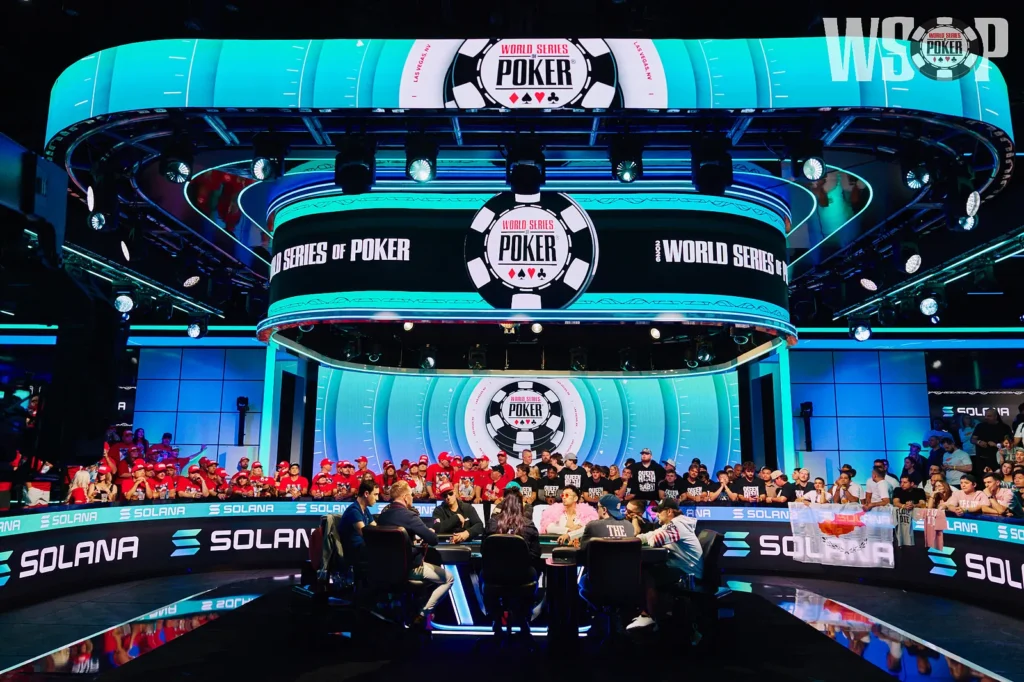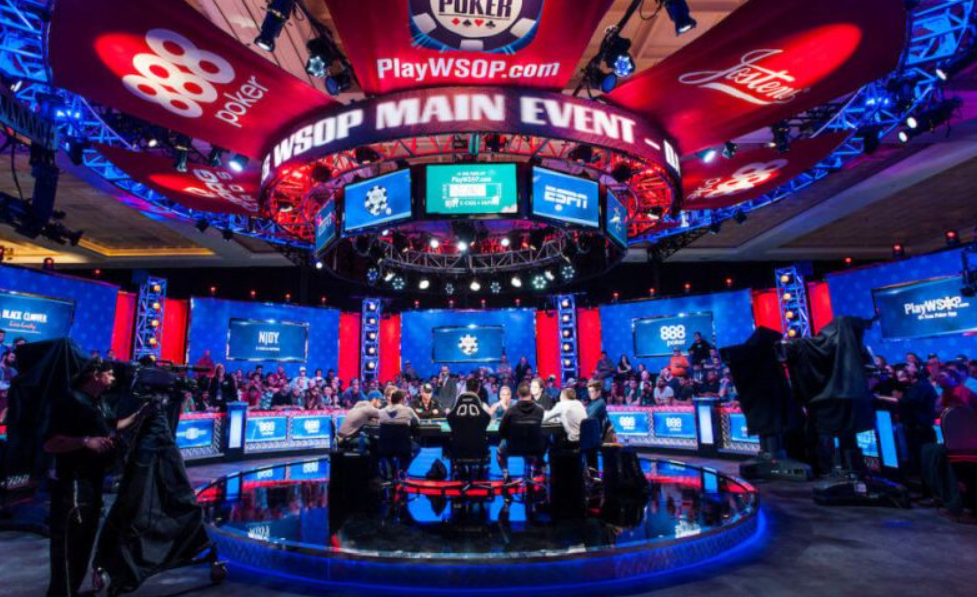


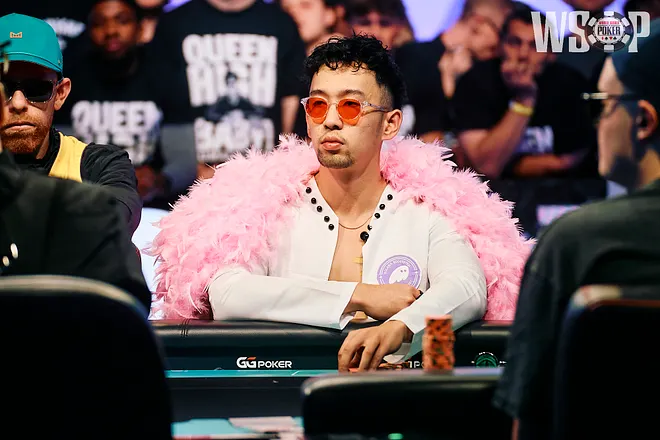
I watched every hand from the first night of the WSOP Main Event final table, and the coverage was great.
Nine players returned from a field of 9,208, each guaranteed at least $1 million and playing for a $10 million 1st place prize.
I loved seeing the full action instead of a highlight package made up almost entirely of all-ins.
The all-ins decide who gets eliminated. The smaller hands often tell us more about how the table is actually being played.
During our Inner Circle coaching session earlier today, we reviewed every major hand that took place at the final table Day 1.
But these five stood out the most.
They showed how a chip leader should apply pressure, why a scary runout does not automatically constitute a bluff, how to use live reads correctly, and why extreme ICM should improve the quality of your aggression.
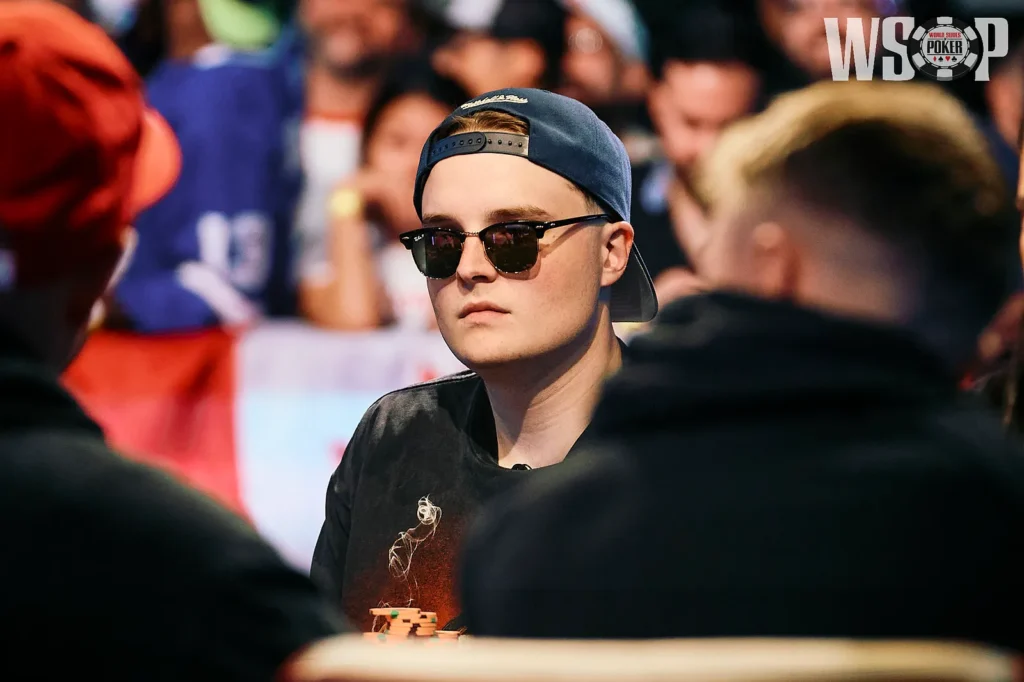
Hand #1: How a Chip Leader Should Use Their Stack
Lucas Jumalon entered the final table with a massive chip lead. Two consecutive hands perfectly showed the difference between using that leverage and giving it away.
First, Jumalon opened A♥5♣ to 4 million. Lauri Saaskilahti three-bet to 10.5 million, and Jumalon four-bet to only 18 million. Saaskilahti five-bet to 57 million with A♣K♠, and Jumalon folded.
I liked Jumalon’s play.
After the three-bet, there was 19.5 million in the pot. Jumalon risked another 14 million to win it. His four-bet did not need to work that often, only 42% of the time to turn a profit, and it put hands such as AJ, AQ, suited aces, and broadways into an awful ICM decision.
He also chose a hand that made sense. A5o blocks strong Ax hands, has a clean fold against a five-bet, and allows the chip leader to pressure a meaningful stack without risking much of his own.
This is exactly what the chip leader wants to do: risk a little to win a lot.
On the very next hand, Jumalon opened 7♥6♥ and called Greg Mueller’s 18 million small-blind three-bet. Mueller had only 42 million left after the call. The flop came A♦Q♠8♦, Mueller bet 12 million, and Jumalon folded.
I think this call is terrible.
Suited connectors are attractive because they can make disguised hands and use position across multiple streets. None of those benefits mattered here. Jumalon created a pot of roughly 40 million against a player with nearly one pot-sized bet left.
There was no room to maneuver. He was not calling to outplay Mueller. He was calling a huge three-bet with seven-high in a low-SPR pot against a likely strong range.
If Mueller had started with another 40 or 50 big blinds, I could see the argument. At this stack depth, Jumalon simply donated chips.
A big stack’s value is not that it allows you to play every pot. Its value is that everyone else has to play against the threat of your stack.
The A5o four-bet preserved that threat. The 76s call gave part of it away.
The lesson: As chip leader, pick lines with asymmetric risk. Be active and win as many pots as possible, but not when the table nit puts in a third of his stack.
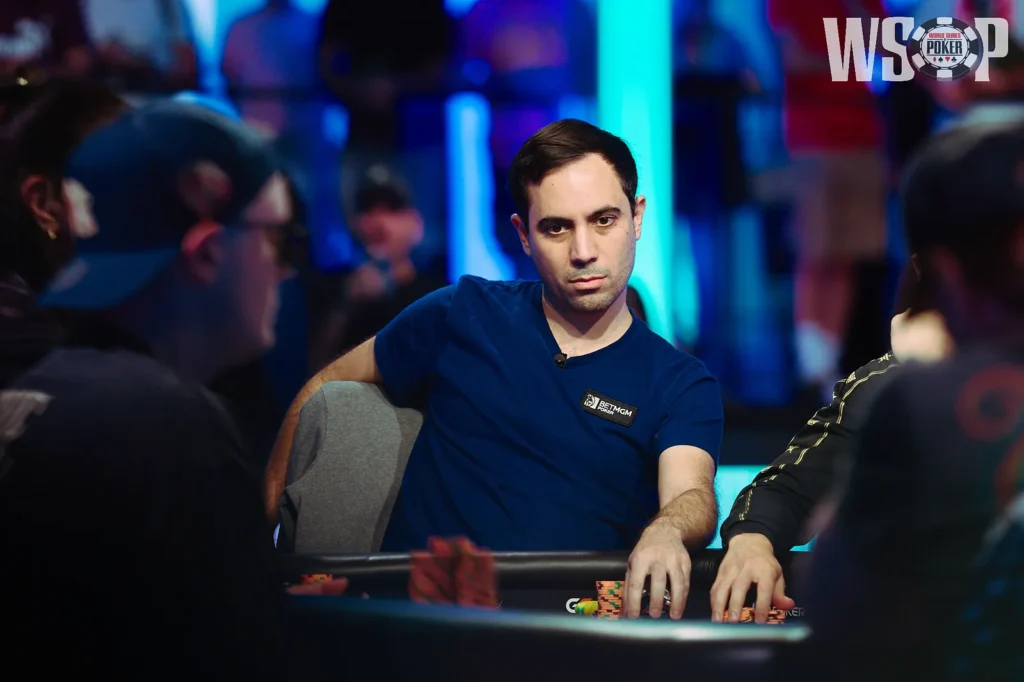
Hand #2: Be Willing to Wave the White Flag
Jumalon raised the button with 6♥4♦, and Michael Gagliano defended A♦6♦ in the big blind. Gagliano check-called 3 million on K♦8♥2♦, then check-called 10 million on the 10♣ turn. The Q♠ hit the river, and both players checked. Gagliano won with ace-high.
Everyone in the lesson wanted to discuss the river because the queen looks like a beautiful card to fire, since Julamon always has AJ and J9, and Gags does not.
On the river, Jumalon had six-high, but he could represent straights, two pair, sets, and plenty of strong one-pair hands. Against Gagliano’s exact A6, a large river bet would have worked. But likely would not have been a good bet vs Gags’ range.
I thought the bigger problem came on the turn.
Under this level of ICM, Gagliano should defend the big blind tighter than he would in a normal tournament. When he check-calls the K♦8♥2♦ flop, his range is already concentrated around Kx and diamond draws.
What folds on the 10♣?
His Kx still has top pair. Several diamond draws either pair the ten or gain more equity. Q♦J♦ and J♦9♦ pick up straight draws. T♦x♦ makes a pair. His suited 8x hands already have showdown value.
The ten looks like a card Jumalon can attack, but it does not actually create many folds.
Once Gagliano calls again, the queen river is not as automatic as it appears either. Jumalon reaches the river with a huge number of missed or weak hands. If he fires all of them because three Broadway cards are on the board, he can quickly become wildly over-bluffed.
This is a mistake I see constantly. Players look at the board, decide a card is “scary,” and start blasting without identifying the hands they expect to fold.
A scare card only matters when it weakens your opponent’s range or strengthens your range enough to change their decision.
The lesson: Don’t blindly bluff. List the actual hands your opponent reaches the street with, then decide whether enough of them likely fold facing a bet.
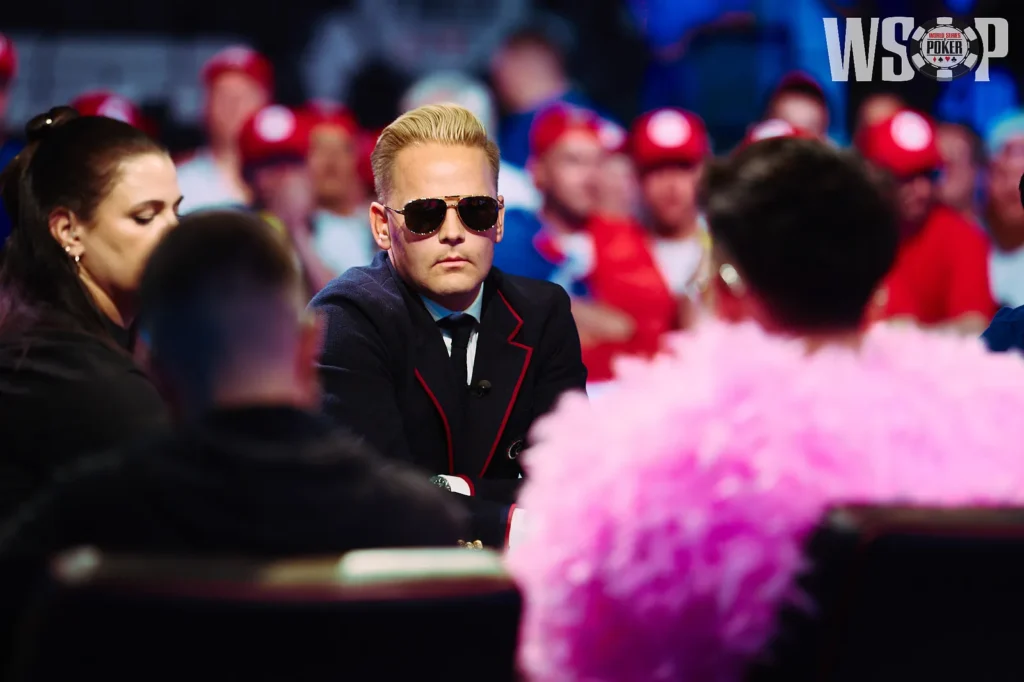
Hand #3: The Best Bluff of the Night
Lauri Saaskilahti opened Q♠8♠, and Greg Mueller called K♠J♦ from the small blind. On K♣6♣4♠, Mueller check-called 3 million. He quickly called another 11 million on the 5♦ turn. The 6♥ paired the river, Mueller checked, and Saaskilahti bet 35 million into roughly 40 million. Mueller folded top pair.
This was one of the most memorable hands of the night, but I want to start preflop.
KJo looks like a decent hand in a lot of spots, but at this final table, calling from the small blind against a player who had not been opening recklessly created a miserable situation. Mueller had to play the entire hand out of position, against an uncapped range, with extreme ICM pressure hanging over every street.
Folding preflop may look tight. It also prevents exactly what happened.
Post-flop, I found the physical sequence told a story.
Mueller appeared uncertain before calling the small flop bet. That could have been genuine, or it could have been an attempt to look weak and encourage another barrel.
On the turn, he called much faster. Then he checked the river in the dark.
We cannot know exactly what Mueller intended, but the sequence looked like this to me:
On the flop: “Please bet again.”
On the turn and river: “I’m calling, but I would really prefer you stop now.”
Physical tells do not always reveal a player’s exact hand. They often reveal what the player wants you to do.
Saaskilahti did the opposite.
Was Q8s the cleanest theoretical triple-barrel candidate? Probably not. His river value range was narrow, and he had plenty of natural bluffs available. But poker is not played against a computer that always responds correctly.
Saaskilahti attacked a capped small-blind range, a player under huge ICM pressure, and a physical sequence that suggested Mueller wanted a showdown.
A more simplistic, often underrated way to say it. Saaskilahti decided to bluff this time, right then, with 10 mil up top, and thought Mueller would fold top pair.
The lesson: Use live reads to sharpen your logical analysis, not replace it. A read is most valuable when it supports a strategic conclusion you can clearly explain.
Hand #4: Always Try to Disappoint Your Opponent
Saaskilahti opened A♣9♣ under the gun, and Jumalon defended K♣10♦ in the big blind. Both players checked J♥J♦2♣. The K♥ landed on the turn, Jumalon checked again, and Saaskilahti bet 4.5 million. Jumalon called. On the 6♣ river, Jumalon led 12.5 million and got called by ace-high.
This may have been my favorite line of the session because it attacked what Saaskilahti planned to do next.
Jumalon played this hand phenomenally.
When players check back the flop and then bet small on the turn, they often have a simple plan:
Bet now, then check back the river.
They may be bluffing, betting ace-high, or holding a marginal made hand. The small bet attacks the big blind’s (typically weak) double-check range while preserving a cheap showdown when called.
Jumalon recognized the plan.
If he check-raised the turn with KTo, Saaskilahti would fold ace-high, and Jumalon would lose the extra value.
If he called and checked the river, Saaskilahti would usually check behind.
By calling the turn and leading a safe river, Jumalon put Saaskilahti in a spot he had not prepared for. Saaskilahti was planning to fold against a turn raise and check back the river. Now he was facing a bet with a bluff-catcher and had to decide whether Jumalon was value betting a king or attacking his weakness.
He called, and Jumalon extracted a bet that almost certainly would not have gone into the pot through a standard line.
There is another benefit. If Saaskilahti has a jack, AK, or KQ and raises the river, Jumalon has a fairly easy fold. Leading may allow him to gain value from the hands checking back while losing less against the top of Saaskilahti’s range.
I am not saying you should start leading every river after calling a delayed c-bet. The line becomes attractive when the turn bet is small, the bettor has many ace-high or marginal hands, the river is safe, and the bettor is likely to check behind.
The lesson: Do not simply react to your opponent’s current action. Ask yourself what they are trying to accomplish over multiple streets. Then adjust accordingly.
Hand #5: ICM Should Improve Your Aggression, Not Eliminate It
Han Feng was fearless, but his best aggressive decisions were not random.
Feng opened K♣J♣ on the button to 5 million. Rami Hammoud three-bet A♣2♠ from the small blind to 17.5 million, and Feng shoved for 55 million. Hammoud folded.
Earlier, Feng opened 9♠9♦ in the cutoff. Jumalon three-bet A♥3♠ from the small blind to 15 million, and Feng shoved for 46.5 million. Jumalon folded.
A common reaction is that Hammoud and Jumalon should not be three-bet bluffing under this much ICM.
I disagree.
Feng was opening more than anyone at the table (other than the chip leader). If nobody fights back because they are scared of a four-bet, he gets to accumulate chips with almost no resistance.
Three-bet bluffs still matter. They generate profit, and they make it possible to get paid when you have a real hand.
The adjustment is to choose better candidates.
A2o and A3o block strong Ax hands and can comfortably fold to a shove. Feng simply woke up with two of the strongest non-premium hands for fighting back.
KJs has equity when called, blocks hands such as KK, JJ, and AK, and more importantly, unblocks (i.e., makes it more likely they have) the small Ax hands opponents commonly use as ICM three-bet bluffs.
Pocket nines are strong enough to shove for value against a wide three-bet range while still benefiting enormously from folds.
The lesson: Extreme ICM does not mean you can’t rebluff an aggressive opponent. It means you need to be selective with the hands you choose.